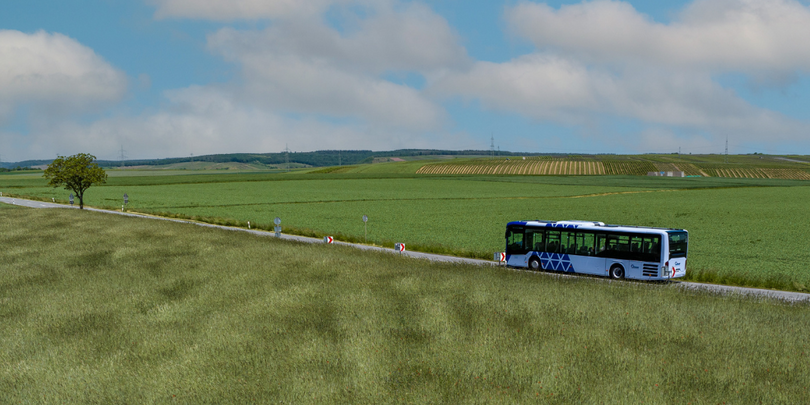
The 2026 Public Transportation Atlas, published in late August by the think tank Agora Verkehrswende, confirms that within the Rhine-Nahe Local Transportation Association (RNN) region, access to public transportation is above the German average—especially outside the major cities.
Based on current schedule data (as of January 31, 2026) and high-resolution
population data from the census, the atlas assesses how well all approximately 11,000 municipalities and 400 districts
in Germany are connected to local public transit. Particularly noteworthy:
Rhineland-Palatinate has the smallest gap between urban and rural areas nationwide.
According to the study, the Bad Kreuznach district ranks among the top three rural
districts in all of Germany. This is based on the public transit concept implemented since 2022 in collaboration with the responsible authorities and
ZÖPNV Süd/Land Rhineland-Palatinate. This ensures, in
, at least a two-hour frequency in all municipalities—in many cases hourly—and, in the
larger cities, every 30 minutes, with connections to central hubs and the
rail network in each case. The Birkenfeld district is also explicitly praised by the study’s authors for
its dense basic service network. The districts of Mainz-Bingen and Alzey-Worms also benefit from the well-coordinated service in the RNN area:
In Mainz-Bingen, approximately 39
percent of the population has very good or good access to public transportation.
“The results of the Public Transportation Atlas show that our long-standing work within the RNN network at
has paid off in the form of a reliable, all-day basic service schedule. Especially in rural areas
, we have made public transportation a matter of course throughout the network area. This is made possible
through the dedicated support of our funding authorities—the state, counties, and
cities—as well as our partners, the transit companies, which reliably
deliver these services on the road. At the same time, the result serves as an incentive for us to further stabilize and expand the quality of
local transit: “A good selection of schedules
combined with reliable service at attractive prices forms the foundation for
passenger growth,” says Silke Meyer, managing director of the Rhein-Nahe
Public Transportation Association.
All results of the 2026 Public Transportation Atlas can be found here.